Product Highlights
BEAMSCAN
Water Phantoms
UNICHECK
Web-based Daily QA
VERIQA
Patient QA Platform
RUBY
Modular QA Phantoms
BEAMSCAN MR
Water Phantom for MRgRT
OCTAVIUS 4D / 4D MR
QA Phantom
Electron Density Phantom
Classical Shape Phantom
Track-it
QA Data Management Platform
flashDiamond
Detector
UNIDOS Tango & Romeo
Reference Class Electrometers
All Radiation Therapy Products
A B C
D
E F
G
H
I
J
K
L
M
N
O P Q R S T U V W
X
Y
Z
Product Highlights
NOMEX
Multimeter
NOMEX
Dosemeter
Track-it
QA Data Management Platform
QRM
Phantoms
All Diagnostic Imaging Products
A B C
D
E
F
G
H
I
J
K
L M N
O
P
Q
R S T U
V
W
X
Y
Z

For quick readers:
A concise summary of the three key questions and answers from this article can be found below.
Jump directly to the Q&A section

Expert Article: More Than a Safety Net

3D EPID In Vivo Dosimetry Supports Clinical Decision-Making in Online Adaptive Radiotherapy

Linacs equipped for online adaptive radiotherapy (oART) are increasingly entering clinical practice, but are still predominantly used for conventional treatments. The decision to opt for online-adaptive treatment must be well justified due to the high daily planning effort. However, in vivo dosimetry using the EPID (Electronic Portal Imaging Device) available on the linac makes it easier to identify which patients would particularly benefit from this new treatment technique. But let’s start from the beginning …

Back-Projection Method for 3D Patient Dose Reconstruction

3D EPID in vivo dosimetry provides an additional safety net in radiotherapy quality assurance (QA) – a fact well established in numerous studies. Patient-related errors such as anatomical changes or systematic errors in patient positioning or the use of immobilization systems, cannot be detected using traditional QA methods such as phantom measurements or dose recalculations. VERIQA RT EPID 3D applies a highly reliable verification method based on a back-projection approach, reconstructing a clinically relevant 3D patient dose from 2D EPID images.

An Algorithm Built on 20 Years of Clinical Experience

VERIQA RT EPID 3D employs an algorithm developed by the Department of Radiation Oncology at the Netherlands Cancer Institute – Antoni van Leeuwenhoek Hospital (NKI-AVL) in Amsterdam. The algorithm builds on 20 years of clinical experience and is complemented by a patent-pending inhomogeneity correction based on the Monte Carlo algorithm. This combination enables accurate dose reconstruction even in treatment regions with significant tissue density variations.

Patient-Specific QA: Monte Carlo vs. EPID

Radiotherapy can involve planning, transfer, machine- and patient-related errors. Monte Carlo-based dose calculations – as performed with VERIQA RT EPID 3D – allow for extremely fast, highly precise plan verification and run automatically in the background. This method is considered the gold standard for dose calculation. However, Monte Carlo calculations only detect planning errors.

When EPID dosimetry is used for pre-treatment plan verification, the treatment plan is irradiated “in air” onto an EPID panel and then reconstructed in a virtual patient. This covers a large portion of the QA error chain: planning, transfer, and machine-related errors. When EPID dosimetry is used in vivo – during patient treatment – patient-related errors are also included.

In Vivo Verification as a Safety Net

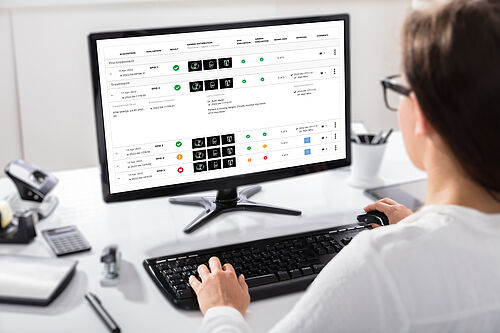
EPID-based in vivo dosimetry requires no additional measurements. Since EPID imaging runs automatically in the background, this method is often referred to as a safety net. VERIQA RT EPID 3D by PTW has been available since May 2025 following extensive clinical testing across Europe. The 3D patient dose reconstructed via back-projection provides well-documented safety – without constant monitoring: a traffic light system with customizable alarm thresholds clearly indicates whether and where closer inspection is needed. For example, deteriorating values from fraction to fraction are a strong indicator that a new planning CT is necessary.


“Based on our experience, we see enormous potential in this tool to enhance treatment accuracy and improve patient safety.”
Dr. Gaspar Sanchez Merino, Txagorritxu Hospital (Spain)


3D EPID In Vivo Dosimetry: Supporting oART Treatment Decisions

Moreover, in vivo dosimetry with VERIQA RT EPID 3D is a helpful indicator in routine clinical practice to determine which patients would benefit most from oART. This new treatment method involves daily planning, which is time- and resource-intensive, but considers the anatomy of the day. EPID-based in vivo dosimetry allows larger patient cohorts to be monitored in the background over time. Based on this monitoring, informed decisions can be made about which treatment regions should be considered for online-adaptive radiotherapy.

For Ann van Esch, who clinically validated VERIQA RT EPID 3D together with the medical physics team at CHU UCL Namur in Belgium, the breast is an ideal region for oART, especially due to shape and size changes caused by swelling.

“What we aim for is to let VERIQA detect changes of dosimetric relevance and alert us when they occur. This allows us to focus our attention where it truly matters – and where adaptive therapy would be most beneficial in the hopefully near future.”
Ann van Esch, PhD, 7Sigma Radiotherapy Physics Belgium

Modularity

Whether treatment plans are verified through measurements or dose recalculations – always within applicable standards – often depends on the clinic’s philosophy and user preferences. A clear trend is emerging: treatment plans are increasingly verified computationally, while phantom-based measurements are reserved for specific situations. Thanks to its modular design, the software-based VERIQA platform allows different verification methods to be flexibly combined and effectively complemented. For example, Monte Carlo-based dose recalculation with VERIQA RT MonteCarlo 3D, used for pre-treatment plan verification, can be clinically expanded with VERIQA RT EPID 3D in vivo dosimetry, covering all relevant error sources.

Getting Started with 3D EPID In Vivo Dosimetry

Introducing EPID-based in vivo dosimetry into clinical practice raises several questions. The strict criteria used for dose verification with VERIQA RT MonteCarlo 3D or conventional phantom-based QA cannot be directly applied to EPID-based in vivo dosimetry. So what criteria should be used? How can the source of an alarm be identified? PTW supports users throughout the entire implementation process – from installation to clinical commissioning. Practical guidance and valuable tips are also provided in a current whitepaper with recommendations from NKI-AVL, Amsterdam, which developed the algorithm and has successfully used 3D EPID dosimetry in QA for 20 years.

Pro Tip: Start with a Phantom

For a safe start with 3D EPID in vivo dosimetry using VERIQA RT EPID 3D, it is recommended to use a phantom before clinical commissioning – for example, Ruby, still the most cooperative “patient”. As an end-to-end phantom, Ruby enables verification of the entire radiotherapy treatment chain. Intentionally introduced error sources, such as anatomical changes or positioning errors, can be easily simulated with Ruby. Comparing these with in vivo results shows users the system’s strengths and limitations and helps them learn how to interpret the findings. This way, VERIQA RT EPID 3D can be safely integrated into daily clinical practice step by step.

Thinking Ahead: Building Know-How for oART

Once experience is gained in handling in vivo results – especially in interpreting them and assessing system strengths and limitations – valuable know-how is already being built that can be directly applied to oART. In oART, traditional measurement-based plan verification before treatment is no longer possible. The patient receives the plan of the day – and this can be efficiently verified during each treatment using EPID in vivo dosimetry. One more reason to become familiar with this verification method.

For further insights into the clinical use and benefits of 3D patient dosimetry, PTW provides webinars and a detailed whitepaper with practical guidance from NKI-AVL.

This article was originally published in EMP News Issue 04 (Winter 2025, EFOMP): Download PDF excerpt.

3D EPID In Vivo Dosimetry: Key Questions & Answers


These three Q&As summarize the core points of the expert article — from the clinical value of EPID in vivo dosimetry and VERIQA RT EPID 3D to its benefits for online‑adaptive radiotherapy (oART) and key recommendations for clinical implementation.

Traditional methods such as phantom measurements or dose recalculations can only detect planning errors. In contrast, 3D EPID-based in vivo dosimetry can identify clinically relevant errors across the full spectrum—including planning, transfer, machine and patient-related issues. VERIQA RT EPID 3D uses a back-projection approach to reconstruct a clinically relevant 3D patient dose from 2D EPID images. The algorithm was developed by the Department of Radiation Oncology at The Netherlands Cancer Institute and builds on 20 years of clinical experience. It includes a patented inhomogeneity correction based on Monte Carlo principles, enabling accurate dose reconstruction even in treatment regions with significant tissue density variations. The system requires no additional measurements, as EPID imaging runs automatically in the background during patient treatment. A traffic light system with customizable alarm thresholds highlights deviations, helping clinicians decide when closer inspection or a new planning CT is needed.

In vivo dosimetry with VERIQA RT EPID 3D helps identify patients who may benefit from oART. This advanced treatment method requires daily planning, which is time- and resource-intensive, yet ensures adaptation to the patient's anatomy on the day of treatment. By enabling the monitoring of larger patient cohorts over time, EPID-based in vivo dosimetry supports informed decisions about which treatment regions are best suited for online-adaptive radiotherapy. As Ann van Esch from CHU UCL Namur emphasizes: "VERIQA helps us detect dosimetrically relevant changes and focus our attention where adaptive therapy would be most beneficial." She highlights the breast as a promising region for oART due to frequent anatomical changes caused by swelling. Experience with in vivo dosimetry also builds valuable expertise for oART, where traditional measurement-based plan verification is no longer feasible, as the patient receives the plan of the day which can be efficiently verified during each treatment using EPID-based in vivo dosimetry.

Introducing EPID-based in vivo dosimetry into clinical practice raises important questions—particularly regarding evaluation criteria and alarm interpretation. The strict criteria used for dose verification with VERIQA RT MonteCarlo 3D or conventional phantom-based QA cannot be directly applied to EPID-based in vivo dosimetry. PTW supports clinical users throughout implementation, and a whitepaper with recommendations from NKI-AVL offers practical guidance based on two decades of experience. Before clinical commissioning, using a phantom such as RUBY is recommended. As an end-to-end phantom, RUBY enables the simulation of anatomical and positioning errors. Comparing these with the in vivo results obtained from VERIQA RT EPID 3D helps users understand the system's capabilities and learn to interpret findings—ensuring smooth integration into daily clinical practice. The modular VERIQA software platform enables flexible combinations of verification methods, such as complementing Monte Carlo-based dose recalculation with VERIQA RT EPID 3D in vivo dosimetry—covering all relevant error sources without additional beam time.

Diese Seite existiert auch in Ihrer Sprache.
This page also exists in your language.
Sprache wechseln Change Language